Reconstruction of a Source of Ibn Isḥāq’s Life of the Prophet and Early Qur’ān Exegesis: A Study of Early Ibn ‘Abbās Traditions
Reconstruction of a Source of Ibn Isḥāq’s Life of the Prophet and Early Qur’ān Exegesis: A Study of Early Ibn ‘Abbās Traditions
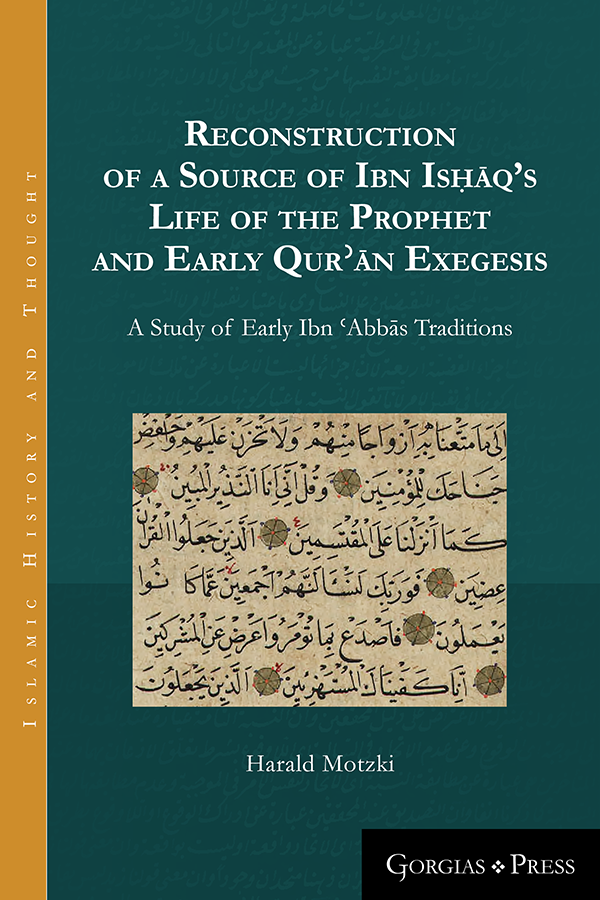
This important work is a source-critical study of a group of traditions (aḥādīth) found in Ibn Isḥāq’s Biography (Sīra) of the prophet Muḥammad, widely considered one of the most important early historical texts on the Prophet’s life. Through a meticulous isnād-cum-matn analysis, the author reveals that Ibn Isḥāq relied on Muḥammad b. Abī Muḥammad, a hitherto undocumented source of his. Important new light is also shed on problems with Ibn Hishām’s recension of Ibn Isḥāq’s Sīra.*
Author: Harold Motzki (retired), is one of the world’s foremost specialists in the field of early and medieval Islamic history and law, on which he has authored multiple groundbreaking books and articles. Together with Professor Gregor Schoeler, Motzki is credited with establishing the isnād-cum-matn methodology, which seeks to reconstruct and date historical texts from the early Islamic period.
Series: Islamic History and Thought 3 ISBN: 978-1-4632-0659-8 Publication Date: May, 2017
Reclaiming Islamic Tradition: Modern Interpretations of the Classical Heritage
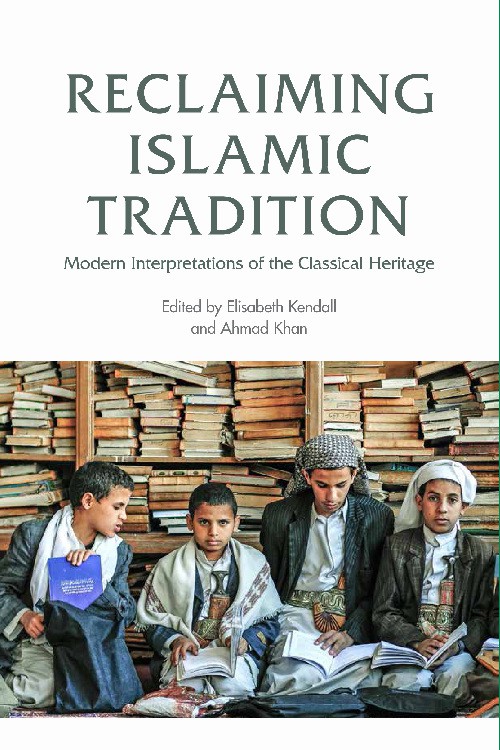
Edited by Elisabeth Kendall, Ahmad Khan
Recent events in the Islamic world have demonstrated the endurance, neglect and careful reshaping of the classical Islamic heritage. A range of modern Islamic movements and intellectuals has sought to reclaim certain concepts, ideas, persons and trends from the Islamic tradition. Reclaiming Islamic Tradition: Modern Interpretations of the Classical Heritage profiles some of the fundamental debates that have defined the conversation between the past and the present in the Islamic world. Qur’anic exegesis, Islamic law, gender, violence and eschatology are just some of the key themes in this study of the Islamic tradition’s vitality in the modern Islamic world. This book will allow readers to situate modern developments in the Islamic world within the longue durée of Islamic history and thought.
Table of contents
Acknowledgements
Notes on Contributors
Introduction, Elisabeth Kendall & Ahmad Khan
1. Modern Shiʿite Legal Theory and the Classical Tradition, Robert Gleave
2. Muḥammad Nāṣīr al-Dīn al-Albānī and Traditional Hadith Criticism, Christopher Melchert
3. Islamic Tradition in an Age of Print: Editing, Printing, and Publishing the Classical Tradition, Ahmad Khan
4. Reaching into the Obscure Past: The Islamic Legal Heritage and Reform in the Modern Period, Jonathan A. C. Brown
5. Reading Sūrat al-Anʿām with Muḥammad Rashīd Riḍā and Sayyid Quṭb, Nicolai Sinai
6. Contemporary Iranian Interpretations of the Qur’an and Tradition on Women’s Testimony, Karen Bauer
7. Ibn Taymiyya between Moderation and Radicalism, Jon Hoover
8. The Impact of a Sixteenth-Century Jihad Treatise on Colonial and Modern India, Carole Hillenbrand
9. Jihadist Propaganda and Its Exploitation of the Arab Poetic Tradition, Elisabeth Kendall
10. Contemporary Salafi Literature on Paradise and Hell: The Case of ʿUmar Sulaymān al-Ashqar, Christian Lange
Index
Communities of the Qur’an–A Conference & Future Publication
By Emran El-Badawi
Contrary to popular belief there is not merely one reception of the Qur’an. In other words, there is no single method of reading, understanding and interpreting Islamic scripture, but rather many. Islamic civilization today has over 1 billion adherents, a rich medieval scholarly-cultural tradition spanning over 1 millennium, and a growing number of new (Muslim and non-Muslim) confessional as well as reformist movements reading the text for a modern world. Demonstrating the complex layers of this diversity was the subject of an conference I convened on Communities of the Qur’an: Modern and Classical Interpretations of Islamic Scripture.
Communities of the Qur’an was dedicated to intellectual inquiry as well as religious dialogue. At its heart this project asks the question, what is the dialectical relationship between the Qur’an and its “communities of interpretation?” How is the relationship between community and scripture mediated? Can a better understanding of each community’s reception, hermeneutics and cultural assumptions bring about a better understanding of the Qur’an for the 21st century? This project also seeks to revive the “ethics of disagreement” found in Classical Islam. The Qur’an interpreters, jurists and theologians of medieval Baghdad, Cairo and Cordoba serve as examples of peaceful coexistence and tolerance in the face of vehement disagreement. On numerous occasions the historical record shows that Muslims from different legal schools or denominations, as well as Christians, Jews, Zoroastrians and others, agreed to disagree.
There is little disagreement about the authenticity of the Qur’an text we possess today.
However, given Islam’s long history, several confessional, scholastic and reformist
communities developed in the shadow of scripture, and arrived at sometimes diverging interpretations of its key passages. These communities include Shia, Sunni, Ahmadi, Feminist and other interpretive traditions. When the text commands, “ask the people of remembrance if you know not” (Q 16:43; 21:7), is it referring to the guided Imams of the prophet Muhammad’s house, to Jews and Christians or another group? Similarly, are there modern re-interpretations of Q 4:34 which states, “men are greater than women” on account of their wealth? Does the text’s identification of its own narratives as the “Sunnah of God” (Q 33:38, 62; 40:23) and His “Hadith” (Q 45:6; 56:81; 77:50) facilitate or forbid the development of a new prophetic Hadith and Sunnah? These are some of the questions and key passages around which have gathered the Communities of the Qur’an.
The challenges of today’s political climate seem greater than that of our predecessors. The religious, social and cultural diversity of the global Muslim community and the richness of its people’s traditions are under threat by extremist fundamentalism. It is Muslims themselves who have paid the greatest price for the intolerance, violence and ‘sectarianism’ undertaken in the name of religion. Furthermore, the discourse surrounding global terrorism and Islamophobia, which has spread in the wake of the September 11th attacks, 2001 and the Arab uprisings of 2011, has only polarized members on both sides of the debate. As a result, the Qur’an, Islam’s sacred scripture and an integral part of world literature, has become the subject of misuse and misunderstanding. More than ever before, leaders from within and without the global Muslim ummah have the opportunity to protect the diversity of Islamic civilization and promote religious tolerance as well as peaceful coexistence broadly speaking.
The conference was hosted by The Boniuk Institute for the Study and Advancement of Religious Tolerance. It hosted presentations by eight international speakers (in order of presentations: Dr. Ingrid Mattson, Dr. Sajjad Rizvi, Dr. Ali Asani, Dr. Ahmed Subhy Mansour, Dr. Amina Wadud, Councelor Mujeeb Ur Rahman, Dr. Todd Lawson, Dr. Aminah Beverly McCloud), three panel chairs (Dr. Hina Azam, Dr. David Cook and Dr. Emran El-Badawi), welcoming remarks by Boniuk director and Rice University Professor, Dr. Paula Sanders, and parting words by philanthropist, Dr. Milton Boniuk. The conference took place March 10-11, 2016, and will eventually turn into a book. Visitors can access VIDEO to all eight presentations at the official conference website HERE.
Claiming Tradition Colloquium at Pembroke College, Oxford
By Nicolai Sinai
OXFORD—In doing modern Islamic intellectual history, it is easy to succumb to the temptation to concentrate one’s analytic efforts mainly on the specifically “modern” aspects of the thinkers and texts in question. In part, this may simply result from identifying one’s subject as “modern Islamic and/or Arabic thought,” extending, as it does, an implicit invitation to think primarily about the novel themes, ideas, and modes of communication that distinguish the intellectual production of the 19th and 20th centuries from earlier ages. In addition, apologetic presentations of modern values and ideas as already enshrined in the canonical sources of Islam often trigger predictable interventions by Western scholars—insisting, for example, that the Qur’anic reference to shūrā cannot really be equated with a call for democracy. However, to primarily position writers of the colonial and post-colonial periods against the background of contemporary events and modern Western thought entails the risk of viewing their moorings in the pre-modern tradition as superficial and rhetorical, or as precluding the exercise of any agency over it. Thus modern writers emerge either as strategically employing traditional concepts and ideas in order to serve as transparent guises for what are “really” imported Western notions, or as compulsively (and sometimes aggressively) parroting ancient traditions in an act of intellectual resistance.
Studying the intellectual history of the modern Islamic world, then, requires a difficult hermeneutical balancing act: without overlooking contemporary references, it is imperative to accord appropriate weight to the manifold and often complex ways in which Islam’s canonical texts and the pre-modern interpretive tradition are invoked, redirected and reconfigured—even where this does not directly contribute to locating an author on an ideal spectrum running from “modernism” to “Islamism.”
That such an approach can potentially facilitate a perception of modern Islamic texts and thinkers as more sophisticated and intellectually serious than they are often presented to be—this was the underlying conjecture throughout the colloquium “Claiming Tradition: Modern Re-Readings of the Classical Islamic Heritage,” which was held at Pembroke College, Oxford, on 27–28 September 2013.
After a keynote lecture delivered by Prof. Carole Hillenbrand dealing with classical and modern understandings of the term jihād, ten scholars based in the UK and Europe examined modern re-appropriations of pre-modern texts, genres, and figures. The topics discussed included modern Shi’ite legal theory (Robert Gleave) and Sunni hadithcriticism (Christopher Melchert), modern contestations over the status of Abū Ḥanīfa (Ahmad Khan) and over the significance of Ibn Taymiyya’s anti-Mongol fatwas (John Hoover), 20th-century Qur’anic exegesis (Islam Dayeh, Nicolai Sinai, Karen Bauer), the use of classical Arabic poetry by Yemeni Jihadists (Elisabeth Kendall) and of the Islamic biographical and historiographical tradition in Zaynab Fawwāz’s (d. 1914) dictionary of famous women (Marilyn Booth), and finally the selection and arrangement of ʿUmar Sulaymān al-Ashqar’s (d. 2012) popular compilation of eschatological traditions (Christian Lange).
From different angles, all the papers illustrated the need for an in-depth mastery of pre-modern sources by students of the intellectual history of the modern Islamic world, as well as the intrinsic interest of modern debates even for scholars of classical Islam.
Études Arabes is one of the publications of Rome’s Pontifical Institute for Arabic and Islamic Studies (PISAI), along with Islamochristiana and Encounter. The latter two periodicals deal with different aspects of Muslim-Christian discourse—Islamochristiana printing research articles and Encounter having a more pastoral scope. Études Arabes, on the other hand, focuses on a single topic, which is treated as a monograph. As such, it aims to be a resource for students and scholars of Arabic and Islamic sciences, by providing a wide introduction to the chosen topic, enriched by an updated bibliography and a series of texts in Arabic (with translations provided in either English, French, or Italian).
Études Arabes’ upcoming issue is devoted to the concept of “Šahīd.” It explores if and how the meaning of the term evolved from the initial Qur’anic occurrence to the current use—both in common and journalistic language as well as in the juridical debate, where the legal status of the “Šahīd” does not seem to reach a consensus among the ‘ulamā and Muslim religious authorities.
Special attention is devoted to the “legal” status of the “Šahīd.” On one hand, such a status is analyzed with reference to its mention in several different places in the Qur’an as well as in the hadith, where the principal meaning is that of witnessing/giving evidence (both in the juridical sense of giving witness in trial, as well as in the eschatological sense belonging to prophets). On the other, the term seems to recur mainly in association with reasons for death, certainly on the path of God (fīsabīl Allāh) and possibly in battle (šahīd al-ma‘raka), but also for many other causes (šahīd al-dunyā wa-l-āẖira): certain illnesses, fires, etc. We recall, for example, that according to a very famous tradition, death while giving birth entitles a women to be “Šahīd” (not “Šahīda,” and this is something to think about). Consequences of being acknowledged as “Šahīd” were mostly related to mourning and burial rituals.
On the other hand, whether or not one is legally “Šahīd” seems to have assumed a much greater importance in these troublesome times, when suicidal attacks have greatly increased and the consequences of a death being considered martyrdom (‘amaliyyāt istišhādiyya) or suicide (‘amaliyyāt intiḥāriyya) can be very crucial for political choices and popular support, as well as for the families of the supposed “Šahīd.”
Keeping in mind its mainly didactic character, Etudes Arabes 110 includes a basic but comprehensive overview of its specific theme. To this end, both the introductory essay and the texts offered in translation[1] are organized in the following way:
Definition of the term “Šahīd” (classical grammar, ancient common use)
The meaning of the term “Šahīd” from the classic Muslim tradition to the contemporary common use
“Šahīd” as a legal status
Contemporary debate: “Šahīd”—martyrdom or suicide (and, as such, condemned)
All themes are treated with ample reference to the Qur’an, classical and “modern” Tafsīr, fiqh, and contemporary jurisprudence.
For more info on PISAI, its activities and how to subscribe to its publications, see www.pisai.it, which features pages in Arabic, English, French, and Italian.
[1] Taken from ‘Abd al-Raḥmān b. Ġurmān b. ‘Abd Allāh al-Karīmī al-‘Umarī, Aḥkām al-šahīd fī l-fiqh al-islāmī, Dār al-bayān al-ḥadīṯ, al-Ṭā’if (al-Mamlaka al-‘arabiyya al-sa‘ūdiyya), 1422/2001, pp. 379.
I offered an undergraduate course last spring for the first time on the Qur’an as Literature. My goal was simple, I wanted my students to read the text closely and interpret its verses themselves. Their apprehension, at first, to commit to this bold exercise soon gave way to an ease and skill with handling the text.
Framing this course on the Qur’an as “literature” emphasized the literary qualities of the text and de-emphasized a theological approach. It meant going deep into the rhyme, rhetoric and homiletic nature of the text. It also entailed divorcing the text, to some extent, from Tafsir. I took some cautionary notes from Andrew Rippin’s article on the pitfalls of “The Qur’an as Literature,”[1], but some of this was new territory for me.
(greenzblog.com)
Part of the course description reads:
This course examines the content and literary style of the Qur’an and in the context of the late antique Near East, ca. 2nd-7th centuries CE. We will read the text alongside the texts belonging to the “People of the Scripture” (ahl al-kitab), i.e. Christians and Jews, and other religious groups explicitly mentioned in the Qur’an. Their scriptures include the Hebrew Bible (al-Tawrah), the New Testament (al-Injil), Zoroastrian texts (cf. al-majus) and Arabian prophetic speech (shi‘r kahin). This comparative approach will provide students with a rich understanding of the Qur’an as an integral part of world literature, and challenge contemporary and traditional assumptions about the text. This approach will also allow the Qur’an to speak for itself, rather than reading it through the eyes of medieval interpretation (Tafsir) or prophetic tradition (Hadith) which began in the 9th century CE. This course also exposes students to some of the scholarly challenges of studying the different layers of a text (Meccan vs. Medinan), identifying its audience, trying to construct the history of its transmission (oral vs. written) without much evidence, and to the limits of translation.
Fortunately, the class size was fairly small, 15 or so, and students came from different religious as well as cultural backgrounds, which made for much lively discussion and debate. Students were pushed to think critically and in a systematic function about the Qur’an, as well as challenge their own assumptions about the text. For students I find two principle barriers that stand between them and the Qur’an. These are the ‘politicization of the text’ on the one hand, and the ‘confusion of the text with traditional interpretation’ on theother. More broadly speaking, I wanted them to appreciate scripture not just as a religious text, but as an integral part of world literature that holds value in the academy.
For an undergraduate course like this, all instruction and materials were in English. Reading materials included How to Read the Qur’an by Carl Ernst(who incidentally has a terrific course on this subject!)[2] and several supplementary articles including: a rhyming translation of Q 93-114 by Shawkat Toorawa, a qur’anic reading of the Psalms by Angelika Neuwirth, and a humanistic reception of the text by me.[3] Students were encouraged but not required to buy a translation of the Qur’an, given the plethora of translations online. (Although for practical purposes we used Yusuf Ali’s translation during class time). Finally, included in the course materials were sections of the Hebrew Bible, New Testament, post-biblical exhortations (e.g. Ephrem the Syrian), Zoroastrian texts and Pre-Islamic poetry. For some students it was the first time they had read the Qur’an; for others the first time they read the Bible. In both cases, students expressed how pleased they were at this eye-opening experience and fruitful exchange.
The course benefited a great deal from following stories posted on the IQSA blog (that’s right, this blog!) and the Qur’an Seminar at the University of Notre Dame, which was still running at the time. To my surprise, students were both curious and welcoming of the technical dimensions of Qur’an study. Some of our best discussions, for example, involved scrutinizing the rhyme of Arabic poetry or considering a particular Syriac word. The course naturally explored a number of qur’anic themes like apocalypticism, prophecy, law, etc, as well as introduced students to debates concerning the text’s chronology, speaker and structure. My happiest moment was when a student expressed to me how the course “made the Qur’an part of a much more intellectual conversation.”
Teaching this course was a tremendous learning experience for both the students and myself. The students learned how to navigate a sometimes unwieldy text and appreciate its tremendous contribution to the world in which they live. Collectively, we learned that as long as one approaches any scripture respectfully as well as critically, the task of understanding it becomes that much easier.
[1] Andrew Rippin, “The Qur’an as literature: perils, pitfalls and prospects,” Bulletin of the British Society for Middle Eastern Studies, 10.1, 1983.
[2] Carl Ernst, How to Read the Qur’an: A New Guide with Select Translations, Chapel Hill, NC: University of North Carolina Press, 2011.
[3] Shawkat Toorawa, “’The Inimitable Rose’, being Qur’anic saj‘ from Surat al-Duhâ to Surat al-Nâs (Q. 93–114) in English rhyming prose,” Journal of Qur’anic Studies, 8.2, 2006; Angelika Neuwirth, “Qur’anic readings of the Psalms” in Ed. Angelika Neuwirth et al. (eds.), The Qur’an in Context, Leiden: E. J. Brill, 2009; Emran El-Badawi, “A humanistic reception of the Qur’an,” Scriptural Margins: On the Boundaries of Sacred Texts, English Language Notes, 50.2, 2012.
CLAIMING TRADITION: MODERN REREADINGS OF THE CLASSICAL ISLAMIC HERITAGE
Organisers: Elisabeth Kendall, Ahmad Khan, Christopher Melchert, Nicolai Sinai
Venue: Pembroke College, Oxford. OX1 1DW
Date: 27-28 September 2013
Both the resurgence of Islamist politics and the political, social, and intellectual upheaval accompanying the Arab Spring challenge us to reconsider the interplay between the pre-modern Islamic tradition and modern proponents of continuity, reform, and change in the Muslim world. The colloquium therefore invites scholars with an in-depth knowledge of the classical Islamicate heritage to explore modern texts that stake out some sort of claim to pre-modern traditions in disciplines as diverse as Islamic law, hadith, Qur’anic exegesis, politics, and literature. The colloquium will encourage specialists to embark on a hermeneutically sophisticated exercise that avoids some of the extremes to which an examination of how the classical heritage functions in the modern Islamic world has often been subjected. The colloquium aims to move beyond works that contain the tacit assumption that modern Muslims are subconsciously steered by the Islamic tradition, without exerting any sort of agency or control over it, and studies that suggest that modern Muslim thinkers arbitrarily distort elements of the tradition to which they lay claim. Instead, we invite scholars to consider modern re-appropriations of pre-modern concepts, texts, persons, and events, and thereby to transcend an increasing bifurcation between classical and contemporary Islamic studies.
Participants:
Carole Hillenbrand (University of Edinburgh), Robert Gleave (University of Exeter), Christopher Melchert (University of Oxford), Ahmad Khan (University of Oxford), Nicolai Sinai (University of Oxford), Islam Dayeh (Freie Universitat Berlin), Karen Bauer (Institute of Ismaili Studies), Elisabeth Kendall (University of Oxford), Marilyn Booth (University of Edinburgh), Jon Hoover (University of Nottingham), Christian Lange (Utrecht University)
Acknowledgement:
This colloquium has been made possible thanks to the generosity of Brian Wilson, a long-standing benefactor of Arabic studies at Pembroke.
Fragmentation and Compilation : The Making of Religious Texts in Islam A Comparative Perspective II (30 septembre – 1er octobre)
Workshop
30 September–1 October 2013
The Institute of Ismaili Studies, London
2nd Floor, Room 2.3
Convenor : Asma Hilali
Abstracts
Fragmentation and Variation in the First Islamic Graffiti (1st–2nd century AH)
Frédéric Imbert, Aix-Marseille University, France
The latest research in the field of Islamic graffiti in the first two centuries AH in the Middle East is uncovering new information about Muslim society at the dawn of Islam. Most of this information concerns the Islamic faith, the place of the Qur’an and the figure of the Prophet Muhammad, but the oldest graffiti also allow us to reflect on the status of writing during the same period. Thousands of Arabic Kufic graffiti recently discovered in Saudi Arabia and in the wider Middle East reflect an extreme fragmentation due to the quantity of inscriptions scattered all over the area. These Arabic graffiti, which were not subjected to any kind of censorship, are the expression of variation and repetition at the same time : variation of the Qur’anic text and of the attitude of people towards the new religion and the Prophet, and repetition of the religious prayers and invocations. The picture of early Islam emanating from the first Islamic graffiti is one of fragmentation.
Repetitions and Variations, and the Problem of ‘Qur’anic Variants’
Asma Hilali, The Institute of Ismaili Studies, London, UK
The field of Qur’anic Studies has been greatly influenced by the medieval reception of the Qur’an text manifested in the exegetical literature and by the theories related to the ‘Qur’anic variants’. The concept of ‘Qur’anic variants’ is deeply rooted in the history of the canonisation of the Qur’an and in the various assumptions made about scribal errors and falsification. My paper will provide a critique of the conceptual tools used in Qur’anic Studies in the last two decades and will propose a new perspective in the study of the textual features interpreted by the medieval and modern scholars as ‘Qur’anic variants’. The new perspective takes the fragmented aspect of the text to be inseparable from the history of its transmission.
Fragmentation, Compilation and Discourse : A Comparison of Three Arbaʿūn Collections on Jihād and Martyrdom Compiled in the Late Mamluk Period
Stephen Burge, The Institute of Ismaili Studies, London, UK
This paper examines the ways in which hadith scholars went about compiling hadith collections by undertaking a comparative analysis of three similar works written in the same period. The three collections are all arbaʿūn collections – short collections of around forty hadith – which focus on the themes of jihād and martyrdom. The three studied are Suyuti’s Abwāb al-suʿadāʾ fī asbāb al-shuhadāʾ (‘The Gates of the Lucky in the Occasions of Martyrdom’) and his Arbaʿūn ḥadīthan fī faḍl al-jihād (‘Forty Hadith on the Merits of Jihad’) and al-Biqāʿī’s Dhayl al-istishhād bi-āyāt al-jihād (‘The Appendix to Martyrdom in the Verses on Jihād’). I will argue that by closely analysing the material included and excluded from a hadith collection, as well as the ways in which the hadith have been arranged, it is possible to gain a deeper understanding of particular nuances within a text in which a compiler does not give his views openly to his reader. This paper will argue that the ‘hadith literature’ contains a vast, almost infinite, body of texts and the job of the hadith compiler is to fragment this wider body of texts, to reconstitute them, and then to arrange them in order to provide a specific discourse on a subject. This process can be seen in the different ways the three works under consideration in this paper respond to the subjects of jihād and martyrdom.
The Qur’an’s Fragmentation and Realignment of Gospel and Talmud
Holger Zellentin, The University of Nottingham, UK
The unique ways in which the Qur’an ‘heard’ select stories from the Aramaic Gospel tradition has been considered by generations of scholars. Yet, only the most rudimentary consensus has been established about the nature of the texts with which the Qur’an’s audience was familiar, let alone the ways in which the Qur’an used these texts. The Qur’an’s utilisation of Talmudic material has received even less attention, and a consensus is even more remote. The present paper seeks to advance, one small step, our understanding of the deployment of both corpora in the Qur’an by considering them jointly. More than occasionally, the Qur’an fragments and realigns demonstrable elements of the (likely oral) Gospel and the Talmudic traditions together in order to solidify its claim of being a correction to the shortcomings of both.
Unity and Fragmentation in the Standard Text of the Qur’an : The Prophet as First Addressee and Dialogic Argumentation. Mehdi Azaiez, CNRS/IREMAM, FRANCE
As defined in discourse analysis, first addressee (or interlocutor) is the person involved in a conversation or dialogue. The figure of the Qur’an’s first addressee is a textual phenomenon linked to the structure of the text and its argumentative dimension. In my contribution, I will define the notion of the first addressee in the Qur’an, its linguistic forms and functions within the entire Qur’an. I will explore the following questions : The variety of the notions of ‘the first addressee’ ; the double aspect of fragmentation/unity of text after its collection and the role of the first addressee in the argumentative shape of the text. My contribution aims to show (i) how the dialogic relation between a Qur’anic enunciator and its first addressee reveals one of the main aspects of Qur’anic argumentation ; (ii) how the Qur’an legitimates the status of its first addressee as a prophet.
Programme
Day 1 : Monday, 30 September 2013
12:00 Arrival of speakers at hotel and lunch
14:00 Welcome
Asma Hilali, The Institute of Ismaili Studies, London
14:00–16:00 Session 1 : Qur’anic Studies : From a Fragmentary Approach to an Approach about Fragmentation
Speakers : Stephen Burge, The Institute of Ismaili Studies, London
Asma Hilali, The Institute of Ismaili Studies, London
Holger Zellentine, The University of Nottingham
Discussant : Prof. Aziz al-Azmeh
This session will examine the state of the field of Qur’anic Studies. It will cover the following topics :
(i) Qur’anic manuscripts : A tool or an aim ?
(ii) Intertextuality : Methodological remarks
(iii) Fragmentation/Compilation perspectives on the Qur’an text in the context of the history of its transmission.
16:00 Break
16:20–17:50 Session 2 : Variation and Repetition in Qur’anic Texts
Chair : Holger Zellentin
Fragmentation and Variation in the First Islamic Graffiti (1st–2nd century AH)
Frédéric Imbert, Aix-Marseille University
Repetitions and Variations, and the Problem of ‘Qur’anic Variants’
Asma Hilali, The Institute of Ismaili Studies
19:00 : Speakers’ Dinner
Day 2 : Tuesday, 1st October 2013
9:00–11:00 Session 3 : Comparative Perspectives
Chair : Mehdi Azaiez, University of Notre Dame, Indiana
Fragmentation, Compilation and Discourse : A Comparison of Three Arba’un Collections on Jihad and Martyrdom Compiled in the Late Mamluk Period
Stephen Burge, The Institute of Ismaili Studies
The Qur’an’s Fragmentation and Realignment of Gospel and Talmud
Holger Zellentine, The University of Nottingham
Unity and Fragmentation in the Standard Text of the Qur’an : The Prophet as First Addressee and the Dialogic Argumentation
Mehdi Azaiez, LabexResmed, Paris
The Traditions on the Composition of ‘Uthmān’s muṣḥaf.
By Viviane Comerro
Viviane Comerro is Professor of Islamic Studies at INALCO (Paris). This blog is a synopsis of its French book titled “Les traditions sur la composition du muṣḥaf de ‘Uthmān”, Orient-Institut Beirut, 2012
When and how did the Quran become a book? Even though paleography and codicology provide us with useful elements that shed light on this question, we should not overlook the study of Islamic literary sources which, through the diversity of their accounts on the writing of the Quran and the richness of their glosses on the Quranic text itself, remain bolder and more informed testimonies than any collection of manuscripts.
(ukaz.com.sa)
How should we address Islamic sources which provide us with numerous pieces of information on this issue? An initial historical approach based on the transmission of texts could lead us to follow the Ancients in their investigative endeavor by privileging the historical veracity of the version adopted by al-Bukhārī (d. 256/870) in his Ṣaḥīḥ.
A second, historical and critical approach has already achieved its full potential: drawing out a core that is common to the various versions of the account of the event so as to gain some certainty or extracting this historical core from its legendary, theological or ideological gangue.
Reflection upon the literary nature of sources that has developed alongside this approach has resulted in a transitory suspension of the “naively” historical approach. In fact, a tradition always provides the event and its interpretation as closely related. This is a khabar, information, as well as a hadith, an event set as an account. Thus, it is in taking into consideration the twofold nature of a tradition that I have read afresh the totality of the accounts on the writing of the Quran by paying very close attention to the variants and their meanings.
By placing back the received version of the event – the one Bukhārī kept in his Ṣaḥīh – in this totality, it appears as made up of several motifs that also exist in isolation as independent traditions. This version is therefore the result of a combination that selects some pieces of information while discarding others.
The author of this combination, or common link in the vernacular of the modern specialists of transmission, is Ibn Shihāb al-Zuhrī (d. 124/742), who certainly did not invent this story but combined different pieces of information on the writing of the Quran, as he did for other accounts.
Beyond this stage, the hadith of Zuhrī evolved even further since a version that is quite different from Bukhārī’s is to be found in the introduction to his Tafsīr by the great compiler of the 3rd century of Hegira, Ṭabarī (d. 310/923).
Apart from the issue of authenticity, wherever we place this version in the chain of transmission, what seems to matter is the reason why such a well-informed exegete as Tabarī chose this version of Zuhrī’s account rather than another one. This question led me to question Bukhārī’s stance and Ṭabarī’s regarding the status of Quranic recitation in the intellectual debates of their time. I came to the conclusion that, to some extent, the issue of the isnād was of secondary importance. What really matters is the content of each account.
For Ṭabarī, who claims that ‘Uthmān reduced the various recitations of the Quran to a single ḥarf in the official muṣḥaf, it is important to note that the Quranic text is not the result of a collection but the writing of a single man, Zayd b. Thābit.
For Bukhārī, it is important to take a stand in a critical debate of his time: that of the created or uncreated Quran, which goes on long after the end of the Miḥna by claiming that the writing of the Quran is created, in contrast with the Hanbali scholars.
Besides, the stance differs from one Ṣaḥīḥ to the other. Muslim (d. 261/875), Bukhārī’s contemporary, who frequented the same circles as him, apparently avoids to take a stand in this debate. Nowhere does he mention the account transmitted by al-Zuhrī. On the other hand, he mentions traditions on the various recitations of the Companions Ubayy, Ibn Mas‘ūd and Abū Mūsā. In this selection of information, one can detect a stand in another significant debate that lasted for centuries about the diversity of Quranic recitations theorized in the form of a prophetic hadith: Unzila l-qur’ān ‘alā sab‘ati ahruf. In this controversy, a stance became more and more a minority, yet it lasted for a long time: it was allowed to liturgically recite ancient qirā’āt, especially that of Ibn Mas‘ūd, due to the fact that the companions of the Prophet and the Successors did it, even though these “readings” were not in keeping with the ‘Uthmānian rasm. It seems that in the 3rd century, prior to Ibn Mujāhid’s reform, the traditionist Muslim was inclined to favor such a stance.
The discrepancies between the accounts about the writing of the Quran, which are already impressive regarding what comes from Zuhrī, are even more so when all the traditions are taken into consideration. They are so not only for the researcher who considers he should not side with the traditionists, now as in the past, but also because all these accounts excluded by the strict selection of the Ṣaḥīḥ reappear in the margin of a commentary or an argumentation by the early (or modern) authors among the most interested in orthodoxy.
Historical description is not the main goal of traditionists, who rather try to solve theological/juridical problems. The diversity of the accounts related to the writing of the Quran, which mostly took place under ‘Uthmān’s caliphate, could result from the traditionists’ worry about the composition of the muṣḥaf in an unfavorable historical context: a challenged caliphate in a time troubled by strong dissensions. The attested circulation of different maṣāḥif of the Quran, one of the sources of legitimacy and authority in the fullest sense of this dīn as the foundation of the new community, represented a danger for Medina’s power. After the historical situation changed, though it was never forgotten, the prime preoccupation concerned the conditions of transmission of the prophetic proclamation. The selection of the ḥarf of Zayd, a man related to ‘Uthmān, had not been consensual. And what to do with the maṣāḥif of Ubayy, Ibn Mas‘ūd, Abū Mūsā, Miqdād and others? Several responses to these unexpressed worries arose in the large corpus of narrative traditions on the writing of the Quran. I have suggested classifying these accounts according to the kind of solution they provided to ensure the faultless transmission of the muṣḥaf.
After this investigation in literary sources, it is to be noted that there is no received version of the writing of the muṣḥaf despite the status acquired by the Ṣaḥīḥ of Bukhārī and the repetition, book after book, century after century, of his hadith on the collection of the Quran, a “thing the Prophet had not done.” In this way, although a 12th century traditionist such as Abū Muḥammad Ḥusayn al-Baghawī reports Bukhārī’s account in his Sharḥ al-Sunna, inhis commentary he carries out a rewriting of the event with the memory of other accounts. He claims that the composition of the muṣḥaf is an act involving the Companions as a collective actor of the ijmā‘: they are those who decided together with ‘Uthmān and those who wrote. This rewriting is as perceptible in the 15th century when al-Suyūṭī began his chapter of the Itqān devoted to the collection of the Quran by the blunt assertion that at the time of the Prophet’s death “the Quran had not been collected.” Throughout the text and in the conclusion of the chapter, it appears that the “thing the Prophet had not done” had in fact been accomplished since the muṣḥaf, organized as verses and suras, is exactly the same as that instituted by Muḥammad after the angel’s dictation.
In my book, I left the question of the writing of the Quran at the time of the Prophet open-ended owing to the scarcity of traditions that mention it. This question pertains to another kind of investigation on the oral/written composition of the Quranic text (Angelika Neuwirth) and could rest on the works of linguists and anthropologists dealing with orality and writing.
In conclusion, the study of traditions informs us on some crucial elements of the history of the text: the plasticity of its composition and oral transmission; the antiquity of its writing; the fixation of a model written under ‘Uthmān; its gradual canonization; the preservation of textual variants as a reflection of the original oral diversity and then the philologists’ interest; the parallel theologizing of the history of transmission.
Yet this study chiefly enables us to understand the Tradition that lends their full weight to the actors of transmission. Through selection, combination, additions or deletions, and when the text is permanently fixed in its letter, through their glosses, commentaries and interpretations, these actors contribute to the fluctuation in meaning in the preservation of religion.
Translation and Exegesis: Travis Zadeh’s The Vernacular Qur’an
By Michael Pregill
The claim that Muslims do not translate the Qur’an, or rather that a translation of the Qur’an is not really the Qur’an at all but only a dim approximation of the basic sense of the text, has often been repeated by scholars. This notion has even informed the production of translations by Muslims themselves at times, as in the case of Marmaduke Pickthall’s famous The Meaning of the Glorious Koran (1930)—the title implying that the text in English represents only the meaning, with something substantial literally having been lost in translation. It is difficult to escape the conclusion that any rendition of the Qur’an into the vernacular—that is, into any language other than the original Arabic—should and must have a secondary and marginal status in Islamic society.
But there is a paradox here, inasmuch as the public recitation and explanation of the Qur’an has played a significant role in attracting converts to Islam since the earliest days of the community’s expansion after the Arab conquests. Historically, the process of reciting and explaining the Qur’an surely involved some element of translation; the parallel with the reading of the Torah and exposition of targum in Jewish synagogue services is obvious here. Further, scholars have often asserted (at least since the time of Goldziher’s seminal Die Richtungen der islamischen Koranauslegung, 1920) that tafsir (Qur’an commentary) most likely originated in this context, built upon the most ancient understandings of the Qur’an that had circulated among the earliest followers of the Prophet. Initially grounded in the need to interpret the Qur’an’s essential message for converts—often with considerable mythological and homiletic expansions—this tradition eventually coalesced into one of the core disciplines within the ulum al-Quran or “Qur’anic sciences.” All of this implies that translation of the Qur’an has in fact been central to Islamic society, at least at times, and that such translation has been absolutely vital for the survival and expansion of the community at numerous junctures in Islam’s long history.
The complex relationship between translation of and commentary upon the Qur’an is explored in depth in Travis Zadeh’s magesterial and far-ranging study, The Vernacular Qur’an: Translation and the Rise of Persian Exegesis (Oxford University Press in association with the Institute of Ismaili Studies, 2012), which specifically examines the phenomenon of translation as it lies at the foundation of both Persian literary and Iranian Islamic religious tradition. The significance of this study cannot be overstated. Iran was most likely the first region or culture area outside of Arabia proper to achieve a Muslim majority. Further, several of Iran’s urban centers became preeminent centers of religious learning in the ninth and tenth centuries, producing ulama whose works became critical for the further development of the religious sciences, especially hadith; and, as is well known, by the high Middle Ages, so-called New Persian came to rival—and eventually surpass—Arabic as the preeminent literary language of Islamic society, at least in the eastern regions of the Dar al-Islam.
Zadeh’s study explores the intersections between theological and juridical controversies, devotional practice, and an emerging Persian literary culture, informed both by an admirable command of the theoretical literature on translation and a nuanced understanding of the complex conjunction of factors that contributed to the misrepresentation of Qur’an translation as somehow inferior or illegitimate. In Western scholarly discourse, the claim of the Qur’an’s untranslatability originates in medieval Christian polemic, in which Muslims’ supposed insistence that the Qur’an can only be approached in the original Arabic was caricatured as proof of Muslim “rigidity” and legalism – ritual rectitude purportedly being more important in Islam than rational understanding. This gross oversimplification of Muslim attitudes was then reinforced by the misapprehensions of more contemporary (and well-meaning) scholars such as Wilfred Cantwell Smith, who inadvertently conflated theological assertions of the Qur’an’s inimitability with some jurists’ opposition to the use of verses of the Qur’an in other languages in the devotional context into a blanket prohibition on translation that somehow applied to all times, places, and contexts.
Smith thus characterized an opposition to translation as somehow essential to Islam, but as Zadeh demonstrates, the translation of the Qur’an into Persian, even for devotional purposes, appears to have been a basic fact in the Iranian milieu; the “early pattern of wrapping the sacred language of the Qur’an in Persian reflects the practical hermeneutic, if not liturgical, importance of approaching scripture through a linguistic medium other than Arabic” (133). Moreover, translation into Persian was not simply driven by the practical considerations of disseminating the Qur’an in a recently converted, and thus only superficially acculturated, population. Rather, Zadeh’s theoretically sophisticated approach shows that the general recognition of the polyvalence of scripture—for example, the idea that the Qur’an was revealed in seven ahruf (modes or recitations)—opened up a wide discursive space in which many scholars not only tolerated but even explicitly sanctioned the ongoing use of the Qur’an in Persian and other languages for a variety of purposes.
Astonishingly, Zadeh’s treatment of his subject stretches from the period just after the Arab conquests of the seventh century all the way to the flourishing of Persian tafsir in the eleventh and twelfth centuries with figures such as Abu’l-Futuh al-Razi, Surabadi, and Isfara’ini, as well as discussing the later reception of this tradition in subsequent centuries. Even as the use of Persian renditions of Qur’anic verses was largely abandoned in specifically devotional contexts, the dynamic interplay between the Arab and Iranian cultural and linguistic milieux continued to inform the evolution of Islam in the Persian-speaking world. As their tradition matured, Iranian scholars continued to have a complicated relationship with Arab Islamic religious authority and exegetical discourse—especially the latter, as “exegesis served as a platform for the articulation of religious commitments” (448), particularly as attitudes towards Persian came to inform and in turn be inflected by sectarian considerations.
This brief notice hardly does justice to Zadeh’s wide-ranging, yet lucidly argued and eloquently written, treatment of the Qur’an in Persian and the Persianate world. We may hope that his nuanced and imaginative study draws attention to this long-neglected subject and inspires new scholarly research in this area in the future.