Book review: Aims, Methods and Contexts of Qurʾanic Exegesis
 By Gabriel Said Reynolds
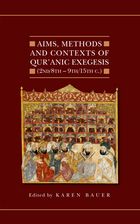
Aims, Methods and Contexts of Qurʾanic Exegesis (2nd/8th-9th/15th C.), ed. Karen Bauer. Oxford: Oxford University Press, 2013.
A principal goal of the International Qurʾanic Studies Association (IQSA) is to encourage scholarship on the Qurʾanic text and its relationship to the historical, religious, and literary context of Late Antiquity. The interest of IQSA in fostering such scholarship is in part a response to the manner in which the academic study of the Qurʾan is often approached through the lens of tafsir. This approach has not done justice to the text of the Qurʾan. It also does not do justice to tafsir, a science that deserves to be studied for its own sake and not only as an accessory to the study of the Qurʾan. In this light the publication of a major volume dedicated to the study of tafsīr, entitled Aims, Methods and Contexts of Qurʾanic Exegesis (2nd/8th-9th/15th C.) and edited by Karen Bauer, is an auspicious development (as will be the forthcoming publication of Tafsir and Intellectual History, edited by Andreas Görke and Johanna Pink).
Aims, Methods and Contexts of Qurʾanic Exegesis, a work based on papers delivered at a 2009 conference at the Institute of Ismaili Studies in London, opens with a clear and compelling introduction by Bauer and is followed by thirteen chapters of almost universally high quality. Bauer divides the articles not by chronology but by theme, into three principal sections: “The Aims of Tafsir,” “Methods and Sources of Tafsir,” and “Contextualising Tafsir.” The work—which includes new editions of Arabic texts in the articles of Walid Saleh and Suleiman Mourad—concludes with a detailed index of Qurʾanic verses, a general index, and a global bibliography.
Here, instead of a comprehensive book review, I would like to draw attention to some highlights in Bauer’s volume. (I’ve also included a complete table of contents below). Among the most interesting contributions in Aims, Methods and Contexts of Qurʾanic Exegesis are those by Bauer herself, both the Introduction and the second chapter: “Justifying the Genre: A Study of Introductions to Classical Works of Tafsir.” In the Introduction Bauer convincingly argues that the science of tafsir is as much about the world of the mufassir as it is about the text of the Qurʾan:
At its essence, tafsir is each scholar’s attempt to relate his world to the world of the Qurʾan; it is his attempt to relate his intellectual, political and social contexts to the Qurʾan’s text. It is a process of meaning-creation, because what the scholars read into the text is not always explicitly there. (p. 8)
In some ways this argument sets the tone for the entire volume, as different scholars show how different mufassirun create meaning, and how their attempts to do so reflect their particular contexts and personalities. Following Walid Saleh’s detailed study and edition of the introduction to al-Wahidi’s Qurʾan commentary al-Basit, Suleiman Mourad presents an examination of the introduction to the Muʿtazili tafsir of al-Hakim al-Jishumi (“Towards a Reconstruction of the Muʿtazili Tradition of Qurʾanic Exegesis,” ch. 4). Mourad stresses the way in which al-Jishumi uses his tafsir as an arena (or, to use Mourad’s terminology, a “battlefield”) in which to refute the doctrines of the Muʿtazila’s opponents.
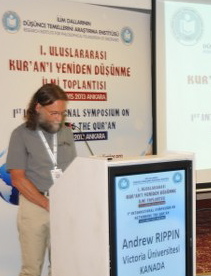
In his article (“Early Shiʿi Hermeneutics: Some Exegetical Techniques Attributed to the Shiʿi Imams”), Robert Gleave explores the way in which certain Shiʿite mufassirun attribute interpretations to the imams. Gleave categorizes these interpretations according to certain exegetical techniques in order to identify what is distinctive in this particular exegetical genre. Andrew Rippin (“The Construction of the Arabian Historical Context”) asks how much of what is generally assumed to be the Arabian historical background of the Qurʾan—even its Arabic language—is a construction of the mufassirun. To this end Rippin comments: “What we have is an interpretational context conveyed in a linguistic, social convention known as ‘Arabic,’ tied to a specifically imagined time and place that ends up being subject to generalisation across the text” (pp. 183-84)
The focus of Martin Nguyen (“Letter by Letter: Tracing the Textual Genealogy of a Sufi Tafsir”) is instead on one particular tafsir, the Laṭaʾif al-isharat of Abu l-Qasim al-Qushayri (d. 465/1072). Whereas Qushayri’s work is often labelled as a “mystical” tafsir, Nguyen shows that this label is simplistic, as the Laṭaʾif al-isharat also reflects the particular trends of Qurʾanic interpretation that were present in Qushayri’s context in Nishapur. While Nguyen’s article presents tafsir as a coherent science with distinct boundaries, Tariq Jaffer’s article (“Fakhr al-Din al-Razi’s System of Inquiry”) highlights the influence of philosophy and theology in Fakhr al-Din al-Razi’s monumental commentary. He thereby shows that in certain cases the boundaries of tafsir are fluid, and indeed that particular tafsirs can be something like compendia of different sciences.
Perhaps the most impressive contributions to Aims, Methods and Contexts of Qurʾanic Exegesis are the two which make up its final section. Claude Gilliot (“A Schoolmaster, Storyteller, Exegete and Warrior at Work in Khurasan: al-Dahhak b. Muzahim al-Hilali (d. 106/724)”) provides a detailed and meticulously documented examination of the exegetical material attributed to al-Dahhak, and the varied (and at times ambiguous or conflicting) traditions on his biography. Michael Pregill (“Methodologies for the Dating of Exegetical Works and Traditions”) examines a text often known (and indeed published) under the title of Tafsir Ibn ʿAbbas. Pregill shows, with reference to the scholarship of Andrew Rippin and others, that the attribution to Ibn ʿAbbas is without basis, as is Wansbrough’s attribution of this text to al-Kalbi. Instead, Pregill contends, this work should be identified with a tafsir entitled al-Wadih, compiled by ʿAbdallah b. al-Mubarak al-Dinawari (d. 308/920). In addition, Pregill convincingly argues through a series of case studies that this text has a distinctive relationship with early works such as Tafsir Muqatil, even if it shares the formal traits of later madrasa style tafsirs. Thus it is a text that “defies easy categorization” (p. 432).
The same might be said for the work in which Pregill’s article is found. The articles in Aims, Methods and Contexts of Qurʾanic Exegesis cover a diverse range of subjects, and are of various sorts, from textual editions, to theoretical reflections, to focused studies on particular works. Together, however, they form an impressive body of scholarship on tafsir. Indeed this volume might serve as a foundation for the development of a distinctive academic field of tafsir studies.
Aims, Methods and contexts of Qur’anic exegesis (2nd/8th-9th/15th C)
Table of Contents
Notes on contributors, XI-XIV.
Bauer (Karen), Introduction, 1-16.
Section I; The aims of tafsir
1. Hamza (Feras), Tafsir and unlocking the historical Qur’an: Back to basics?
19-37
2. Bauer (Karen), Justifying the genre: A study of introductions to Classical works of tafsir, 39-65
3. Saleh (Walid A.),The introduction of Wahidi’s al-Basit: An edition, translation and commentary, 67-100
4. Mourad (Suleiman), Towards a reconstruction of the Mu’tazili tradition of Qur’anic exegesis: Reading the introduction of the Tahdhib of al-Hakim al-Jishumi (d. 494/1101)and its application, 101-137.
Section II.Methods and sources of tafsir.
5. Gleave (Robert), Early Shi’i hermeneutics:Some exegetical techniques attributed to the Shi’i Imams, 141-172.
6. Rippin (Andrew), The construction of the Arabian historical context in Muslim interpretation of the Qur’an 173-198
7. Tottoli (Roberto), Methods and contexts in the use of hadiths and traditions in classical tafsir literature: The exegesis of Q. 21:85and Q. 17:1, 199-215
8. Ngyuen (Martin), Letter by letter: Tracing the textual genealogy of a sufi tafsir, 217-240
9. Jaffer (Tariq), Fakhr al-Din al-Razi’s system of inquiry: Doubt and the transmission of knowledge, 241-261
10. Zamah (Ludmila), Master of the obvious: understanding zahir interpretations in Qur’anic exegesis, 263-276.
11. Burge (Stephen), Jalal al-Din al-Suyuti, the Mu’awwidhatan and the Modes of Exegesis, 277-310.
Section III. Contextualising tafsir
12. Gilliot (Claude), A schoolmaster, storyteller, exegete and warrior at work in Khurasan: al-Dahhak b. Muzahim al-Hilali (d. 106/724), 311-392.
13. Pregill (Michael E.), Methodologies for the dating of exegetical works and traditions: Can the lost tafsir of al-Kalbi be recovered from Tafsir Ibn Abbas (also known as al-Wadih)?, 393-453
Bibliography, 455-490.
Index of Qur’anic citations, 491-494.
General index, 498-802
© International Qur’anic Studies Association, 2014. All rights reserved.