
The International Qurʾanic Studies Association is delighted to announce that the ninth annual Andrew
Rippin Best Paper Prize (open to papers delivered by early career scholars at the 2025 Annual Meetings)
has been awarded to Salma Albezreh for her paper: “Who But You Can Save Us? Allāh’s Theological
Position in Ancestral Arabian Religion and Its Relevance for Understanding the Qurʾānic Opponents.”
The winner of the Andrew Rippin Best Paper Prize receives a cash award. In addition, an expanded and
edited version of the winning paper qualifies for publication in the Journal of the International Qur’anic
Studies Association.
This award is given in honor of Professor Andrew Rippin (1950–2016), a leading scholar of the Qurʾān
and inaugural president of the International Qur’anic Studies Association (2014). Prof. Rippin is
remembered as “an esteemed colleague, revered mentor, and scholarly inspiration to many members of
the IQSA community.”
An abstract of the award-winning paper follows:
This paper presents two previously unpublished Safaitic inscriptions documented during the 2025 season of the Badia Epigraphic Survey, directed by Ahmad Al-Jallad. Found in the basalt desert of northeastern Jordan, these texts shed new light on the religious landscape of pre-Islamic North Arabia. While the Safaitic corpus has yielded invaluable evidence for local cults and pantheons, direct textual evidence for the specific cultic status assigned to Allāh has remained limited. Building on Al-Jallad (2025) and others, the inscriptions presented here provide new data for reconstructing the function and position attributed to Allāh in ancestral Arabian religion. These texts contain formulaic prayers and invocations in which Allāh is explicitly invoked as a guide and as a final recourse within a graduated hierarchy of supernatural help, specifically during long-distance travel and in times of environmental distress.
These findings are particularly relevant for contextualizing the Qurʾānic text. The Qurʾān frequently engages in a polemical discourse with its interlocutors, contrasting polytheistic practice with a singular, monotheistic devotion to Allāh. A key rhetorical strategy, exemplified in verses like Q 29:65, is to accuse the Meccan mushrikūn of appealing to Allāh exclusively when facing danger at sea, but reverting to their polytheistic practices once delivered to safety. The newly discovered Safaitic inscriptions provide a tangible, pre-Qurʾānic epigraphic backdrop for this very discourse. They demonstrate that the practice of invoking Allāh in opposition to other deities in moments of desperation, especially during perilous journeys, was indeed a feature of ancestral Arabian religion. This paper presents the two inscriptions, analyzes their linguistic and religious significance, and discusses how they refine our understanding of the historical realities behind the Qurʾānic polemic.
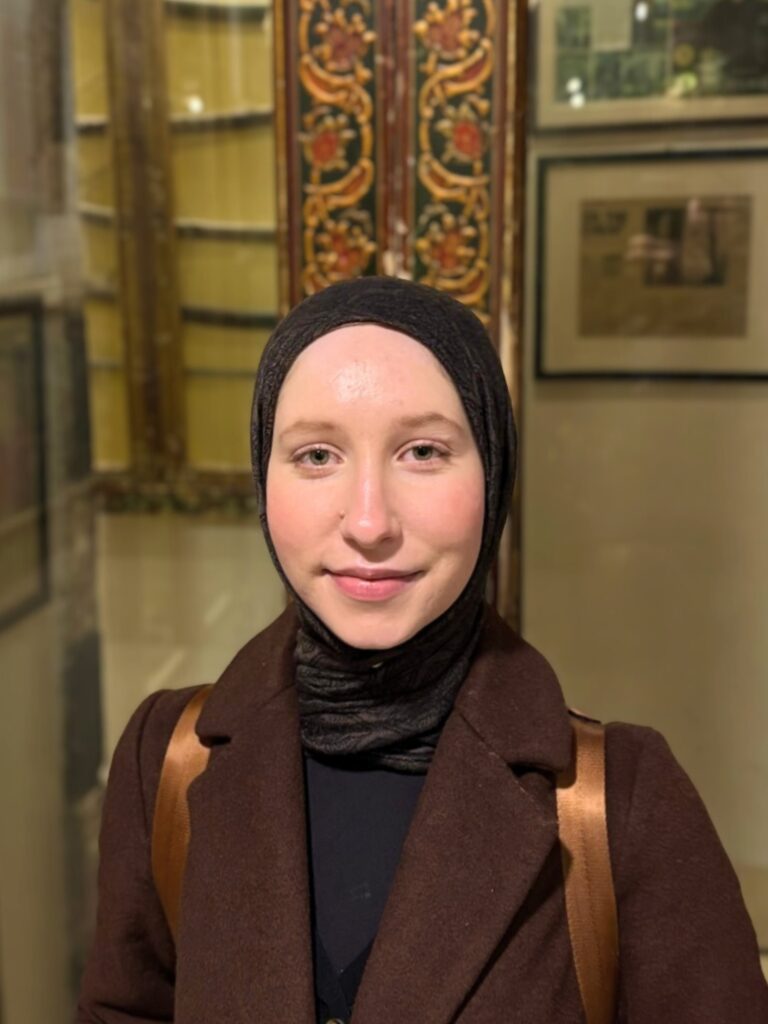
Salma Albezreh is a master’s student and incoming Melton Fellow in the Department of Near Eastern and South Asian Languages and Cultures at The Ohio State University, where she previously earned her B.A. in History and Islamic Studies as a Stamps Eminence Fellow. Her research interests include the Qurʾan, pre-Islamic and early Islamic epigraphy, ancestral Arabian religion, and the religious developments of Late Antiquity and early Islam.
Thank you to all who entered papers for the Andrew Rippin Best Paper Prize! We look forward to your presentations and papers following this year’s Annual Meeting in Vienna (July 8-11, 2026).